...

NAPLAN Year 5

NAPLAN YEAR 5 · AT A GLANCE

NAPLAN Year 5 — Quick Facts

Move from finding an answer to explaining the evidence and checking the method.

Year 5

NAPLAN year

Primary school

8–9

Typical age

Years old

4

Tests

Writing · Reading · Conventions · Numeracy

40 min

Writing

On paper

175 min

Total test time

Across the four tests

112d 06h 40m 45s

Countdown

until NAPLAN starts 10 March 2027

Timings are the standard 2027 arrangements. Your school will confirm the timetable and any adjustments.

TEST STRUCTURE · YEAR 5

NAPLAN Year 5: timing at a glance

The four tests are sat in this order during the test window, with writing on day one.

187 minutes

of test time · 4 tests · 133 questions + 1 writing prompt · writing online

Test 1 · Day one

Writing

Narrative or persuasive · on paper

1 prompt 40 min
Test 2

Reading

Understanding and interpreting texts · online

39 questions 45 min
Test 3

Conventions of language

Spelling (25) and grammar & punctuation (27) · online

52 questions 45 min
Test 4

Numeracy

Number, measurement and data · online

36 questions 45 min

Allow extra time. Instructions, practice questions and breaks are additional. All four tests are completed online.

YEAR 5 PDF BUNDLES

Year 5 PDF test bundles

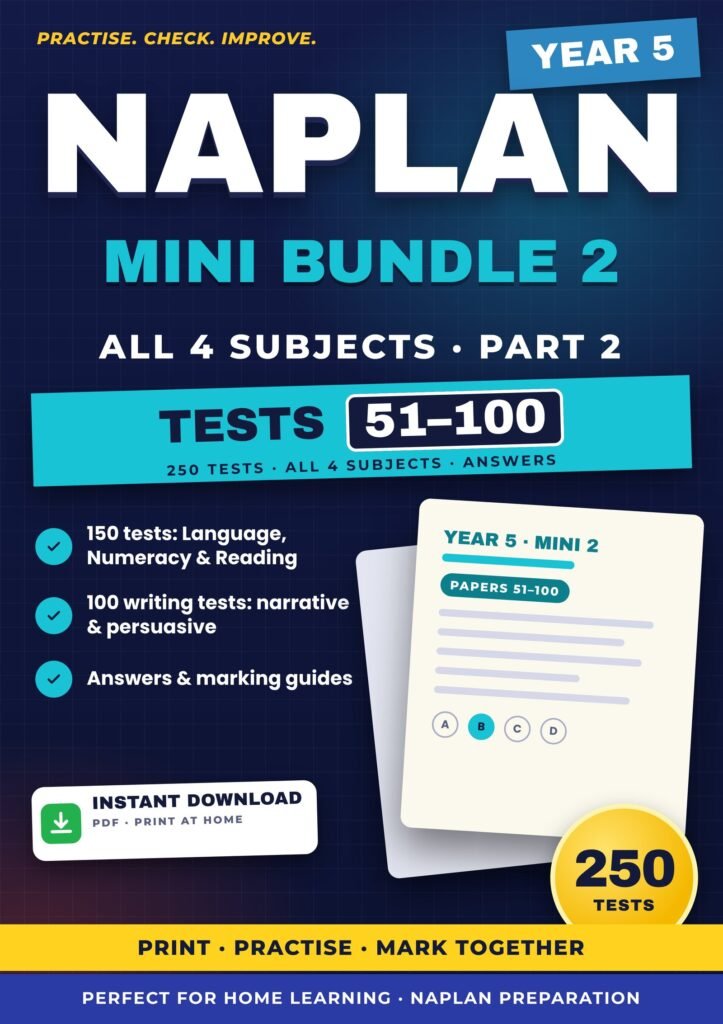
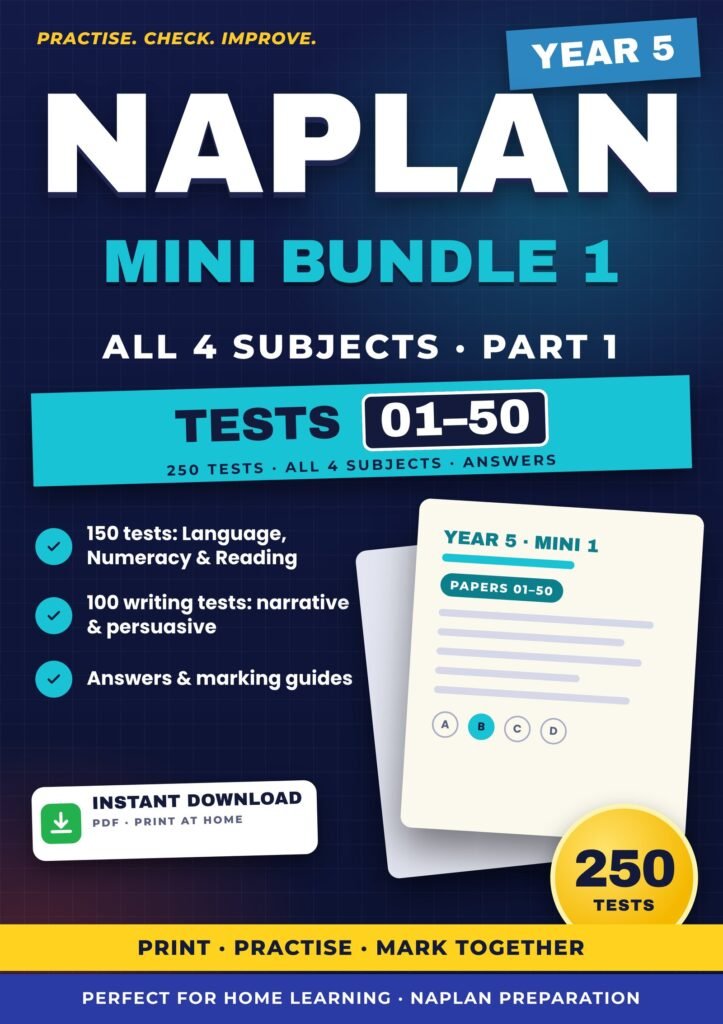
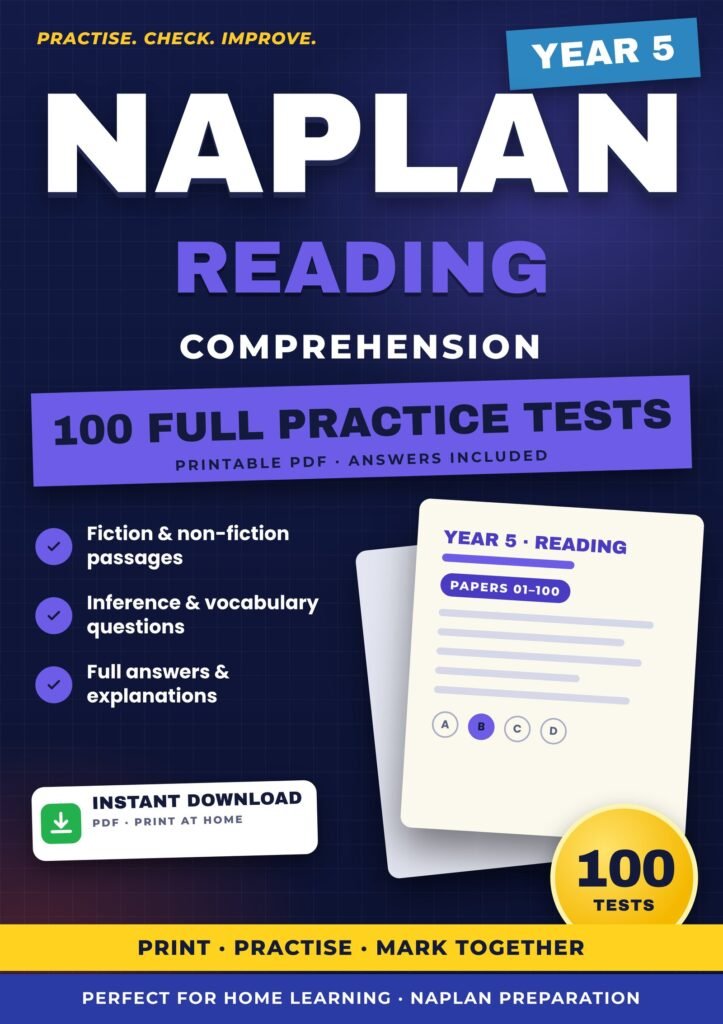
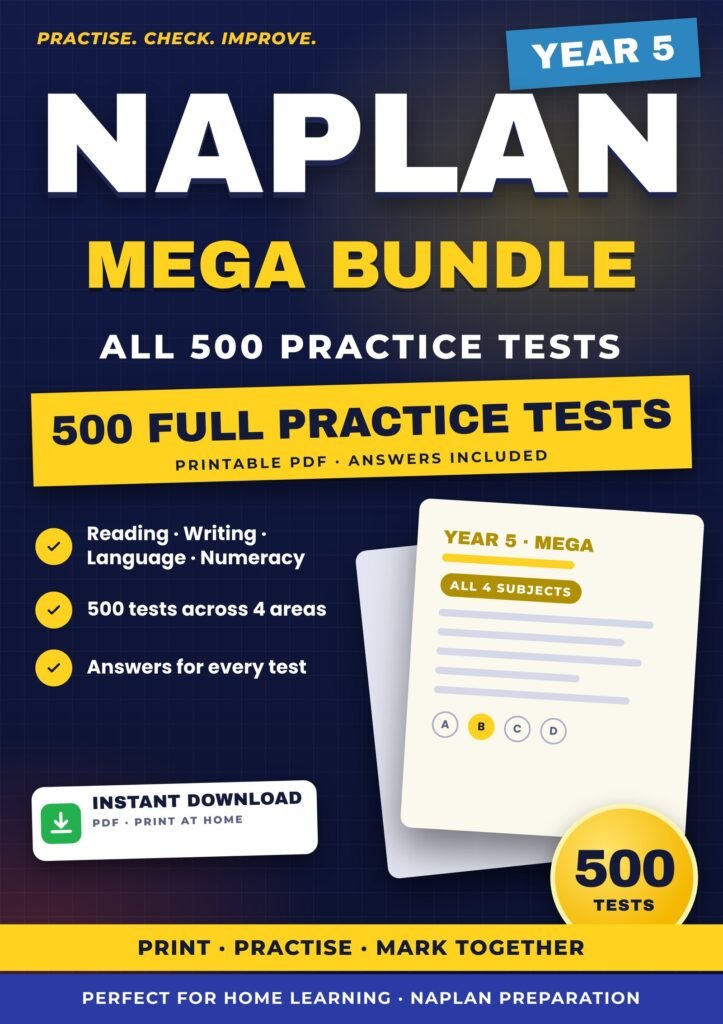
Printable practice tests with answers. Practise one test area with 25 tests, or get all 100 together.

YEAR 5 WRITING EBOOKS

Year 5 writing ebooks

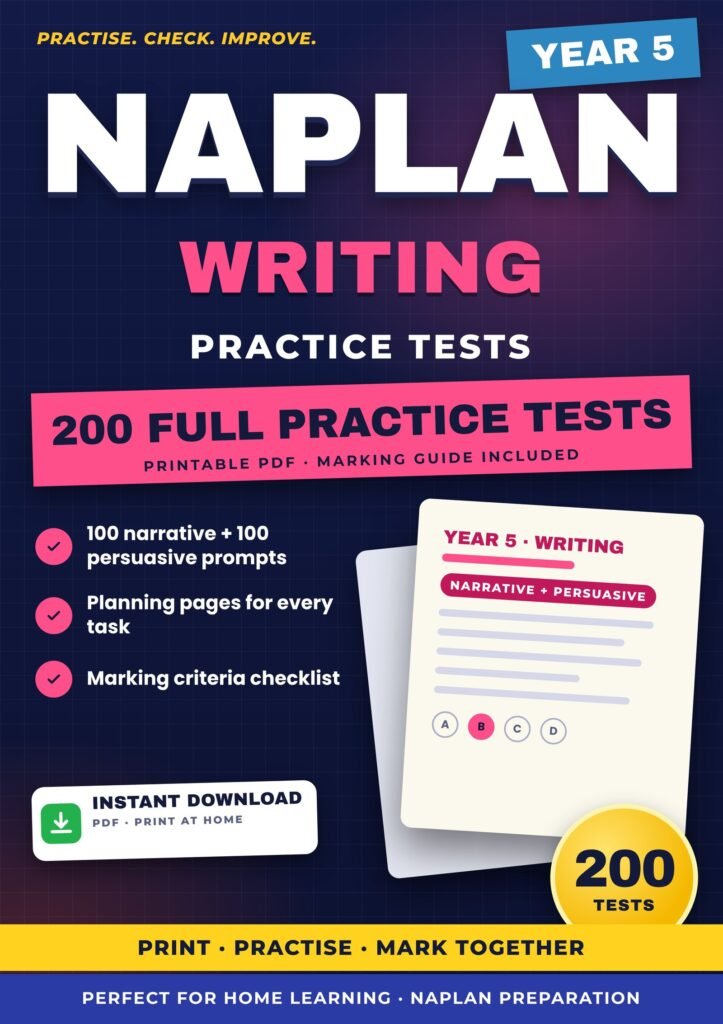
Students don’t know whether they will get a narrative or a persuasive prompt, so it pays to practise both.

YEAR 5 WRITING TESTS

NAPLAN Year 5 Online Practice Tests

Timed, on-screen practice like NAPLAN Online, with instant marking and an explanation for every question.
Year 5Primary

Year 5 NAPLAN Online Tests

10–11Ages
100 tests4 areas
187 minReal NAPLAN time
Explore Year 5 Package100 Online Tests →

NAPLAN YEAR 5

A practical focus for Year 5.

Our teaching suggestions for each test area, with one useful approach to practise at home.

01

Reading

Reading with evidence

Compare details across paragraphs and explain unfamiliar words using nearby clues.

Useful approach

Connect clues from two different paragraphs.

02

Writing

Writing with purpose

Develop paragraphs with examples. For stories, show how a character responds to a problem; for arguments, explain why a reason matters.

Useful approach

Give every reason its own paragraph and example.

03

Conventions of language

Accurate language

Edit tense, subject–verb agreement, apostrophes and sentence punctuation in short passages.

Useful approach

Check apostrophes: one owner or many?

04

Numeracy

Numeracy with reasoning

Practise fractions, measurement and data in context, showing each step in a multi-step problem.

Useful approach

Estimate first, then check the answer is sensible.

What do writing markers look for?

Your child writes either a story (narrative) or an argument (persuasive). Each type has its own marking guide with 10 criteria.
Narrative writingMax 47 marks
Criterion · what markers look forScore
1AudienceOrients, engages and affects the reader0–6
2Text structureOrientation, complication and resolution, organised effectively0–4
3IdeasCreating, choosing and crafting ideas for the story0–5
4Character and settingDevelops characters, and a sense of place, time and atmosphere0–4
5VocabularyRange and precision of word choices0–5
6CohesionLinks ideas across the text with referring words and connectives0–4
7ParagraphingParagraphs that help the reader follow the story0–2
8Sentence structureCorrect, well-built, meaningful sentences0–6
9PunctuationCorrect punctuation that helps the reader0–5
10SpellingAccurate spelling, including harder words0–6
Persuasive writingMax 48 marks
Criterion · what markers look forScore
1AudienceOrients, engages and persuades the reader0–6
2Text structureIntroduction, body and conclusion, organised effectively0–4
3IdeasChoosing relevant ideas and developing them0–5
4Persuasive devicesUses a range of devices to support the position0–4
5VocabularyRange and precision of word choices0–5
6CohesionLinks ideas across the text with referring words and connectives0–4
7ParagraphingParagraphs that help the reader follow the argument0–3
8Sentence structureCorrect, well-built, meaningful sentences0–6
9PunctuationCorrect punctuation that helps the reader0–5
10SpellingAccurate spelling, including harder words0–6

Make sense of the report

Results show four proficiency levels: Exceeding, Strong, Developing and Needs additional support. They are a starting point for a conversation about learning.

See an example NAPLAN report

ACARA shows what a real student report looks like, with the symbols explained, on its official results page.

FROM ACARA

Official past NAPLAN papers (2008–2016)

ACARA publishes real Year 3 NAPLAN papers and answers from 2008 to 2016. They open on ACARA’s website. ACARA does not release tests after 2016.

2012–2016 papers

Reading, language conventions, numeracy and writing, with answers.

2008–2011 papers

The earlier paper tests, with answers.

THE PARENT READING ROOM

Helpful reading for Year 5 parents

Scroll to Top
Seraphinite AcceleratorOptimized by Seraphinite Accelerator
Turns on site high speed to be attractive for people and search engines.