 Skip to content


Year 7 NAPLAN Numeracy: Front, side and top views
Year 7 · NAPLAN Numeracy · Geometry: 3D, Nets and Views · 10 min read
A view is what you see when you look straight at an object from one direction. The front view shows the tallest cube in each column, and the top view shows the footprint. Year 7 NAPLAN Numeracy asks you to pick the correct view, or to work back from views to the stack.
Front, side and top
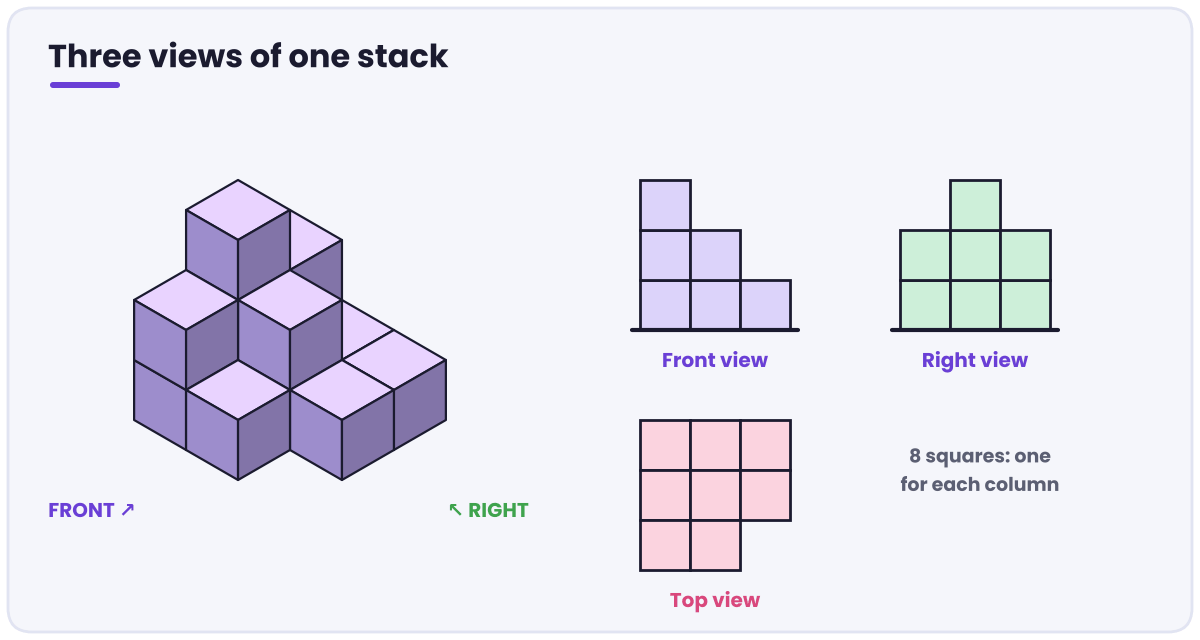
Each view flattens the stack
- Front view: for each column left to right, draw the tallest stack.
- Side view: the same, looking from the side.
- Top view: a square for every place that has at least one cube.
- Views never show depth, so different stacks can share the same views.
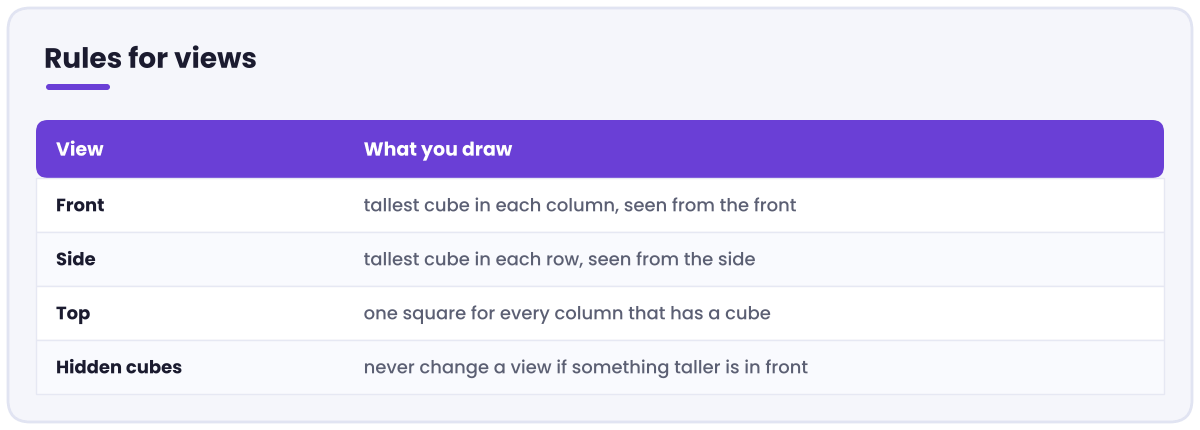
What each view shows
| WORKED EXAMPLE 1 A single row of towers is 1, 2 and 3 cubes tall from left to right. What does the front view look like? Step 1 Each tower shows its full height. Step 2 Columns of 1, 2 and 3 squares: a staircase going up to the right. Answer: A 1, 2, 3 staircase |
| WORKED EXAMPLE 2 · Top view In the stack above, how many squares are in the top view? Step 1 One square for every column with a cube. Step 2 There are 9 places and one is empty, so 8 squares. Answer: 8 squares |

Views can match more than one stack
| WORKED EXAMPLE 3 · Fewest and most (three steps) The top view is a 2 × 2 square. The front view shows columns of 2 and 1. What are the fewest and most cubes possible? Step 1 Each of the 4 places has at least 1 cube. Step 2 The left column needs a 2 somewhere: fewest = 2 + 1 + 1 + 1 = 5. Step 3 Both left places could be 2: most = 2 + 2 + 1 + 1 = 6. Answer: Fewest 5, most 6 |
| COMMON MISTAKE Drawing hidden cubes in a view. Mixing up left and right in a side view. Adding heights in a view instead of taking the tallest. |
Practice questions
Questions 1 to 4 use the stack below. Questions 1 to 4 are like the non-calculator part. You may use a calculator for 5 to 8.
Question 1 (non-calculator) Which describes the front view, left to right?

A Columns of 3, 2, 1 B Columns of 2, 3, 2
C Columns of 2, 1, 1 D Columns of 1, 2, 3
Question 2 (non-calculator) Which describes the right view?
A Columns of 3, 2, 1 B Columns of 2, 3, 2
C Columns of 1, 1, 2 D Columns of 3, 3, 3
Question 3 (non-calculator) How many squares are in the top view?
Answer: ______
Question 4 (non-calculator) How many cubes are in the stack? (No cubes are missing underneath.)
A 8 B 11
C 13 D 15
Question 5 (calculator) The top view of a stack is a 3 × 4 rectangle. Every column is 2 cubes high. How many cubes are there?
Answer: ______
Question 6 (calculator) The top view of a stack is an L-shape of 4 squares. The front and side views show every column only 1 cube high. How many cubes are there?
A 3 B 4
C 6 D 8
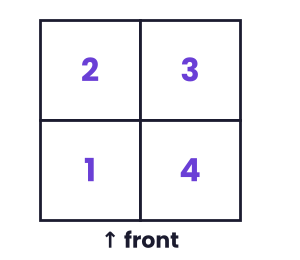
Question 7 (calculator · 2-step) This top-view plan shows how many cubes are in each column. What does the front view look like, left to right?
A Columns of 2, 4 B Columns of 3, 4
C Columns of 2, 3 D Columns of 1, 4
Question 8 (calculator · 3-step) These are the top, front and right views of a stack. What is the greatest number of cubes the stack could have?

A 9 B 11
C 12 D 18
Answers and working
1. A. Tallest in each column: 3, 2, 1.
2. B. Tallest in each row: 2, 3, 2.
3. 8.
4. C 13. 2 + 1 + 1 + 3 + 2 + 1 + 2 + 1.
5. 24. 12 columns × 2.
6. B 4. One cube in each place.
7. A. Left column: taller of 2 and 1 = 2. Right column: taller of 3 and 4 = 4.
8. C 12. Each place can be at most the smaller of its front and right heights. Left column 3 + 3, middle 1 + 1, right 2 + 2: 12.
Ready for more Year 7 NAPLAN practice?
One blog builds the skill. Regular, timed practice with real NAPLAN-style papers is what turns it into marks on test day. Here are three ways to keep going with Year 7.
1. Year 7 NAPLAN PDF Mega Bundle – 500 practice tests

Click the image to see the bundle
Everything for Year 7 NAPLAN in one printable download: Numeracy, Reading, Language Conventions and Writing, all in the same style as this blog’s practice questions. What’s inside:
- 500 full practice tests (printable PDF)
- Language Conventions 01–100: 5,200 questions
- Numeracy 01–100: 4,800 questions
- Reading Comprehension 01–100: 4,800 questions
- Writing 01–100: 200 prompts (100 narrative + 100 persuasive)
- Total: 14,800 questions + 200 writing prompts
- Answers and marking guides for every test
- Costs less than buying the 4 bundles separately – and less than both Mini Bundles

| TRY BEFORE YOU BUY Not sure yet? Download the free sample guide and try real pages from the bundle with your child first. It’s free and needs no account. |

Only need Numeracy? The Year 7 Numeracy Practice Tests 01–100 bundle has 100 full tests with 48 questions each, with a non-calculator then a calculator section (4,800 questions in total), plus worked solutions for every test. Try the free Numeracy sample.

2. NAPLAN Year 7 Online Practice

Click the image to open the SmartExams practice pack
Prefer practising on screen, like the real online NAPLAN test? The SmartExams NAPLAN Year 7 pack has full online tests across Reading, Numeracy, Language Conventions and Writing. It works on any device, and your child gets instant feedback with detailed explanations.

3. Year 7 NAPLAN ebooks


- Year 7 Narrative Writing Guide – plan and write a stronger story for the NAPLAN writing test.
- Year 7 Persuasive Writing Guide – build a clear argument with reasons and evidence.
- Browse all Year 7 NAPLAN ebooks and every Year 7 PDF bundle.
